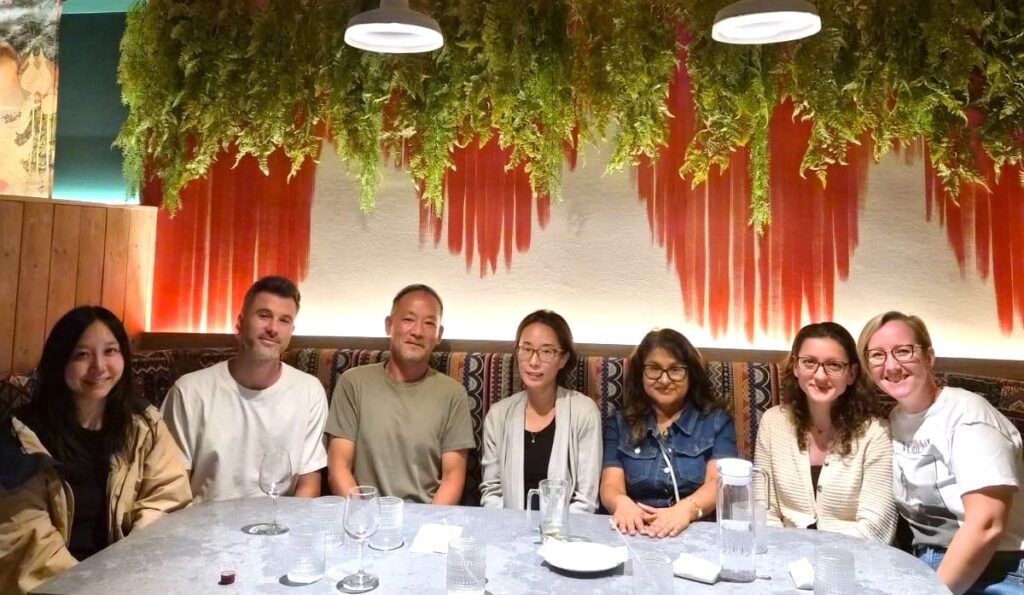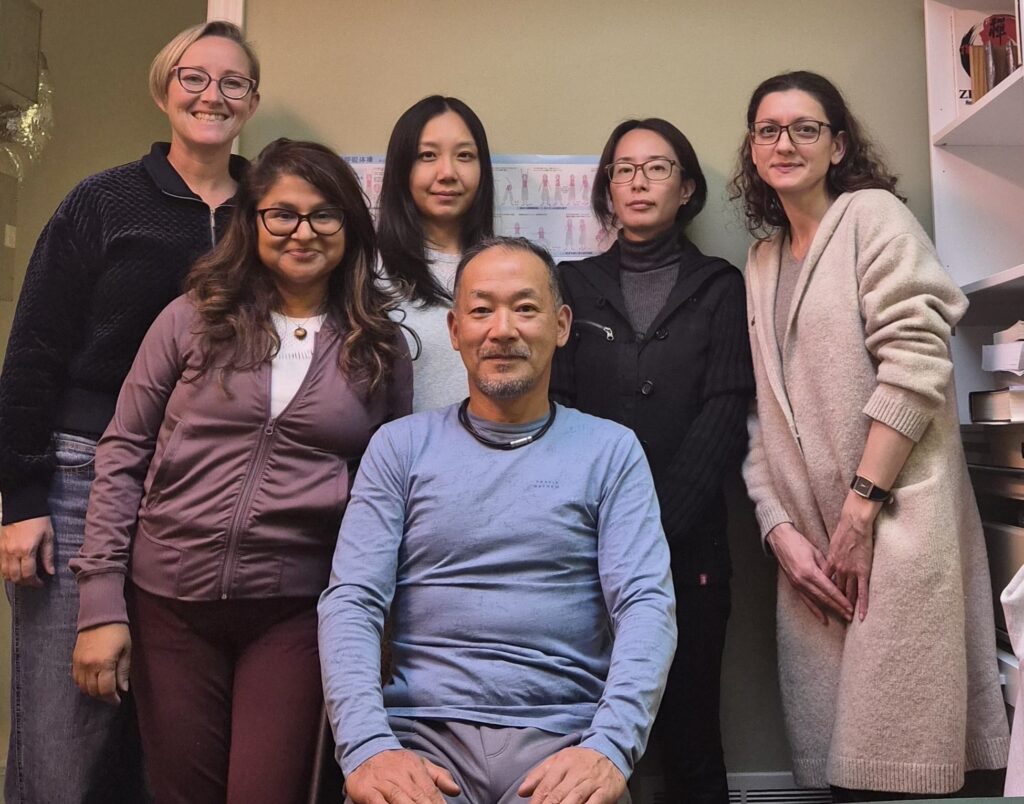
During our most recent clinical study session with Takamasa Tsurusaki Sensei, our group engaged in an in-depth discussion centered on two complex case studies and the better understanding of when to use the counterclockwise diagnostic.
The session unfolded as an open dialogue rather than a lecture. We shared our clinical impressions and questioned our assumptions.
As practitioners, we often find ourselves navigating between surface symptoms and deeper organ issues, especially when patients present with overlapping signs—physical pain, emotional reactivity.
The first case involved a male patient with autoimmune disease, emotional, chronic abdominal cramping, pain, and long-standing neck and shoulder tension. Hara palpation diagnosis revealed firmness and sharpness in the liver and kidney areas. The discussion highlighted the importance of distinguishing cramping pain, linked to the liver and tendons, from aching pain, often related to blood circulation and the heart, to identify whether the root is physical, emotional, or both.
The practitioner used a gentle liver-focused approach with needling (Liver 4, 5, 1), moxibustion on Liver 3, and gallbladder 41, ultimately softening the abdomen and easing neck tension. Takamasa Sensei affirmed starting with surface layers to create changes in the chief complaint and incorporating moxibustion when patients are taking pharmaceutical medications, as it helps stabilize the system more effectively.
Key takeaway: begin gently, observe the body’s response, and allow each treatment to guide the next step in healing.
We discussed the counterclockwise (CCW) approach within the Seino system, Takamasa Sensei explained the counterclockwise (CCW) approach is used when a patient’s mind moves ahead of the body. This technique helps“bring the mental back,” restoring balance between the physical and
emotional.
When symptoms persist or new discomfort arises, treatment may shift through the cycle Liver 4,5,1 to heart — depending on whether the condition is chronic or acute.
Sensei emphasized that CCW is not a fixed technique but a flexible concept, guided by observation, sensitivity, and timing—allowing each treatment to unfold naturally according to the patient’s changing condition.
Our final case, we examined a 40-year-old woman suffering from recurring “rainbow” headaches during menstruation and chronic neck tension following childbirth. The discussion unfolded into an exploration of how postpartum changes, hormonal balance, and channel relationships shape both acute and chronic presentations.Takamasa Sensei emphasized that headaches appearing at the onset of menstruation indicate an acute liver–gallbladder fu channel sign, while preventative treatment should address the uterus as the root as the uterus is a fu organ. Treating the surface first allows deeper regulation to follow naturally.
He reminded practitioners that female symptoms often alternate monthly, reflecting ovarian cycles. Moxibustion was highlighted as essential for stabilizing hormonal and circulatory function, especially when patients are depleted or taking medications.
The conversation expanded into postpartum recovery, where insufficient rest or shock during delivery can lead to blood stagnation that can resurface at menopause as hot flashes, depression, or joint pain. Sensei noted that the knee area (Kidney 10, Liver 8) plays a key role in hormonal balance, linking reproductive health with the immune and endocrine systems.
We also discussed the thymus and immune regulation, noting that points like REN 17 and DU 12 help balance the thymus, strengthen immune system and support the prevention of serious disease.
Our dialogue reinforced Takamasa Sensei’s guiding principle that the Seino system is a concept—one that guides practitioners to address what is present, harmonize the surface first, and allow the body’s deeper patterns to unfold through mindful observation and gradual, responsive treatment. Equally, Sensei emphasized that technique, particularly the precise use and grade of moxibustion, the shape of the rice-grain moxa, and the selection of tools andmethods, must reflect the same sensitivity and awareness as diagnosis itself.
The practitioner’s touch, timing, and intention become part of the dialogue with the body, ensuring that treatment remains both effective and deeply attuned to the patient’s condition.
We’re deeply grateful to Takamasa Sensei for his warmth, generosity, and guidance, continually inspiring us to refine our practice and embody the true spirit of the Seino system in our clinical work.